+91 8401451216





 November 23, 2026
 6 Min Read
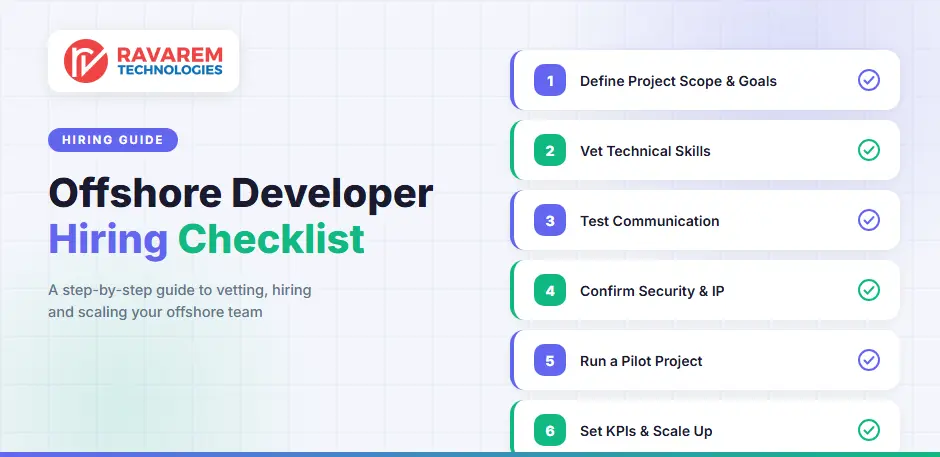
Hiring offshore developers can save you money and get your product built faster. But skip the vetting, and it can cost you months of lost time and rework.
That’s why you need an offshore developer hiring checklist before you sign anything. A clear, step-by-step process helps you separate serious partners from those who look great on a sales call but fall apart during delivery.
According to the US Bureau of Labor Statistics, software developer roles are projected to grow much faster than average through 2034. Local supply can’t match that demand, so more US companies are hiring globally. The question isn’t whether to go offshore. It’s how to do it without getting burned.
Here’s the checklist that keeps you on track.
The Complete Offshore Developer Hiring Checklist
1. Clarify Your Project Scope and Goals
Write down what you’re building, why it matters, and what success looks like. Include the tech stack, team size, timeline, budget range, and any compliance needs. The clearer your brief, the faster you’ll spot vendors who actually fit.
2. Choose the Right Engagement Model
Not every project needs the same setup. A fixed-price contract works for small, well-defined builds. A dedicated offshore development team suits long-term products where requirements shift. Staff augmentation fills short-term skill gaps. And an offshore development center gives you an entire engineering hub that runs like your own branch office. Pick the model before you start reaching out.
3. Shortlist Countries by Skill, Cost, and Time Zone
India offers the largest talent pool and deep enterprise experience. Eastern Europe is strong in engineering and design. Latin America gives you closer time zones. Match the region to your priorities, whether that’s budget, niche skills, or working-hour overlap.
4. Verify the Company’s Track Record
Look beyond the company’s own website. Check verified reviews on Clutch and GoodFirms. Ask for two or three client references and actually call them. Find out what went wrong during the engagement, not just what went right.
5. Review Their Portfolio for Relevant Work
A company that builds eCommerce platforms may not be the best fit for a healthcare SaaS product. Look for case studies in your industry and with your tech stack. If they can’t show relevant work, that’s a flag.
6. Assess Technical Skills With Real Tests
Resumes aren’t enough. Run a live coding test, a take-home assignment, or a paid trial sprint that mirrors your actual work. Have your senior engineers review the output. You’ll learn more in a few hours than in any number of interviews. For a full walkthrough, see this guide on how to find offshore developers.
7. Test Communication and English Proficiency
Talk to the people who will actually write your code, not just the account manager. Hold a video call. Check how clearly they explain technical decisions, how quickly they respond, and whether they ask good questions. Poor communication sinks more offshore projects than poor code does.
8. Confirm Security and IP Protection
Ask about their data security policies, access controls, and whether they hold certifications such as ISO 27001 or SOC 2. Make sure your contract includes a signed NDA, clear IP assignment to your company, and rules about code access and storage.
9. Check Their Development Process
A reliable offshore development company follows agile practices, uses CI/CD pipelines, runs code reviews, and tracks work in tools like Jira or Linear. Ask them to walk you through their sprint cycle. If they can’t describe it clearly, they probably don’t follow one consistently.
10. Evaluate Scalability
Your team needs may change. Ask how quickly they can add or reduce developers. A partner with a deep bench of offshore developers can scale your team in weeks, while a small shop might take months.
11. Understand Their Pricing Structure
Get a detailed cost breakdown. Know what’s included in the hourly or monthly rate and what’s extra, such as project management, QA, or infrastructure. For typical market ranges, see this breakdown of offshore software development costs.
12. Confirm Time Zone Overlap
Agree on at least two to four hours of daily overlap for standups, code reviews, and quick decisions. Teams that never share working hours rely entirely on async communication, which slows down anything urgent.
13. Run a Paid Pilot Project
Before you commit long term, start with a two-to-four-week paid pilot. It shows you code quality, communication habits, and delivery speed under real conditions. If it goes well, you scale with confidence.
14. Define KPIs and Reporting
Set clear metrics from day one: sprint velocity, bug rates, response times, and deployment frequency. Agree on weekly or biweekly reports, so you’re never guessing how things are going.
15. Plan for Onboarding and Knowledge Transfer
Even experienced dedicated offshore developers need time to learn your product, codebase, and workflows. Budget for a proper onboarding period. Document your architecture, coding standards, and business context so the team can get productive quickly.
Top 10 Benefits of Hiring Offshore Developers
Once you’ve checked every box above, here’s what a well-chosen offshore team delivers:
- Lower development costs. Offshore rates can run 40–70% below US market rates, freeing budget for growth.
- Access to global talent. India alone has over 5 million tech professionals, according to NASSCOM. You’re no longer limited to your local job market.
- Faster time to market. A ready-made team starts in weeks, not the months it takes to recruit locally.
- Round-the-clock productivity. Time zone differences let work continue while your US team sleeps.
- Easy scaling. Add five developers for a launch, scale back after release, without layoffs.
- Specialized expertise. Need AI, cloud architecture, or DevOps? Offshore teams often have these specialists on hand.
- Reduced overhead. Your partner covers office space, hardware, HR, and software licenses.
- Focus on core business. Offload development and QA so your in-house team can focus on strategy and customers.
- Lower hiring risk. Your partner handles recruiting, onboarding, and replacements if someone leaves.
- Long-term strategic advantage. Deloitte’s Global Outsourcing Survey shows that most executives now treat outsourcing as a source of innovation, not just savings.
For a deeper look at these benefits, read our guide on the advantages of offshore software development.
Conclusion
An offshore developer hiring checklist isn’t red tape. It’s the difference between a team that ships great software and one that drains your budget with delays and rework.
Start by defining your scope and engagement model. Vet every partner on track record, technical skill, and communication. Lock down security and IP terms before any code is written. Run a pilot before you commit, and set clear KPIs from day one.
The companies that succeed with offshore development aren’t the ones who found the cheapest rate. They’re the ones who did their homework first. Follow this checklist, and you’ll hire dedicated developers who feel like a real part of your team.