+91 8401451216





 October 22, 2026
 10 Min Read
Offshore development can cut MVP costs by 40–60% because engineering rates in countries like India are 60–75% lower than in the US. After you add project management, communication, and coordination costs, the real savings for a typical MVP usually land between 40% and 60%. Quality stays high when the offshore partner uses screened developers, code reviews, automated testing, and tools like SonarQube, and works in Agile sprints with regular demos.
Most founders don’t run out of ideas. They run out of runway.
You have a product you believe in, a few early users waiting, and maybe a seed round that has to last 18 months. Then the quotes come back from US agencies: $180,000 to $250,000 for a first version, and four to six months before anyone can use it.
This is why more US startups now build their MVPs with offshore development teams. They aren’t looking for the cheapest coders they can find. They want to get a working, well-built product to market for a fraction of the cost, and keep enough money left to iterate once real users start giving feedback.
This post breaks down where the savings come from, what a realistic budget looks like, where the hidden costs are, and how to keep quality from slipping along the way.
What Is Offshore MVP Development?
Offshore MVP development means hiring a software team in another country, usually one with lower labor costs, to design, build, and launch the first working version of your product. That team handles some or all of the work: product discovery, UI/UX design, front-end and back-end development, QA testing, and deployment.
An MVP (minimum viable product) is the smallest version of your product that solves a real problem for real users. Its job is to test your core assumptions before you commit serious money to a full build.
Offshore development and MVPs fit together well because both are about getting the most learning for the least spending.
Where Does the 60% Cost Saving Actually Come From?
The short answer is labor rates. Building an MVP is mostly paying skilled people for their time, so the hourly rate drives almost the whole budget.
1. Lower engineering rates
According to the US Bureau of Labor Statistics, the median annual wage for software developers in the US was about $133,000 in 2024. In major tech hubs like San Francisco, Seattle, or New York, senior engineers often earn well above that.
Once you add benefits, payroll taxes, equipment, software licenses, and office space, the fully loaded cost of a US developer is usually 1.25 to 1.4 times their salary. Hiring takes time too: filling a senior engineering role in the US often takes two to three months.
Compare that with typical hourly rates for software development work:
| Engagement Type | Typical hourly rate (USD) |
| US-based development agency | $120-$200 |
| US freelancer (senior) | $90-150 |
| Eastern Europe agency | $45-$75 |
| India-based offshore development company | $25-$50 |
Rates vary by technology stack, seniority, and engagement model. These are general market ranges, not quotes.
The gap between US and Indian rates is often 60–75%. That gap is the starting point for your savings.
2. No recruitment or hiring overhead
Building an in-house team means paying recruiters, posting jobs, running interviews, and onboarding each hire. With good offshore development services, the partner handles sourcing, screening, HR, payroll, and compliance. You meet a shortlist of developers who have already passed technical tests, and work can start in weeks instead of months.
3. No long-term fixed costs
An MVP is an experiment. If it works, you scale. If it doesn’t, you pivot. With an in-house team, a pivot can mean layoffs, severance, and unused office space. An offshore team lets you scale up or down without those costs.
4. Faster time to market
Speed saves money too. Every month your MVP isn’t live costs you salaries, burn rate, and missed learning. An experienced offshore team that has shipped dozens of MVPs already has proven architectures, reusable components, and a delivery process. That often cuts weeks off the timeline.
Time zones can also help. A team in India can work while your US team sleeps, so you can review progress in the morning and send feedback before their next day starts.
A Realistic MVP Cost Comparison
Here’s what this looks like with real numbers. Take a typical SaaS MVP: a web app with user authentication, a dashboard, a few core workflows, payment integration, an admin panel, and basic analytics.
A build like this usually takes about 1,400 to 1,800 hours across product discovery, UI/UX design, development, QA, and deployment. The comparison below uses 1,600 hours.
| Cost Item | US Agency | Offshore team (India) |
| Blended hourly rate | $150 | $40 |
| Development hours | 1600 | 1600 |
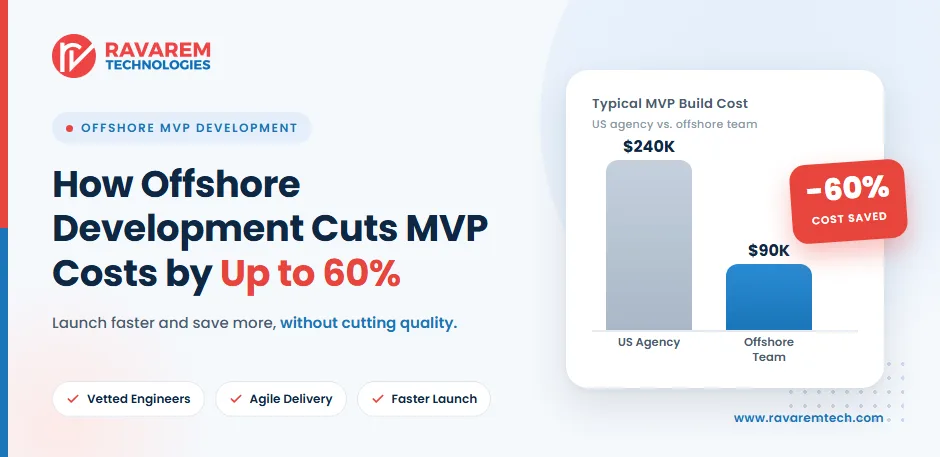
| Build cost | $240,000 | $64,000 |
| Extra coordination and management (your side) | Minimal | $15,000 – $25,000 in time and tools |
| Buffer for communication and revisions | Included | 10% (~$6,400) |
| Estimated total | $240,000 | $85,000-$95,000 |
| Net saving | – | 60% |
The rate difference alone is about 73%. But an honest comparison has to include the extra time you’ll spend on calls, reviews, and project oversight. After those costs, the net saving is about 60%. With a less experienced partner, or a vague scope that causes rework, the saving drops to 40% or below.
That’s why the headline says “up to 60%.” A good offshore team can deliver that saving. A poor one can wipe it out.
How Offshore Teams Keep Quality High (and How to Check It)
The biggest worry founders raise about building offshore isn’t cost. It’s quality. Everyone has heard about the startup that saved $50,000 on development and then spent $100,000 rebuilding the product.
Those failures usually have the same causes: no vetting, no process, and no visibility. Here’s what a quality-focused offshore partner does differently.
Thorough developer screening
Strong offshore development companies test candidates on real coding problems, review their past work, and run technical interviews before anyone joins your project. At Ravarem, developers go through both technical and communication screening, because a strong engineer who can’t explain a tradeoff will still slow you down.
1. Code quality standards
Ask any potential partner how they measure code quality. The answer should be specific, for example:
- Static code analysis with tools like SonarQube to find bugs, vulnerabilities, and code smells before they ship
- Peer code reviews on every pull request
- Test-driven development (TDD) or at least solid unit and integration test coverage
- CI/CD pipelines that run tests automatically on every commit
If a vendor can’t show you a sample quality report or explain their review process, treat that as a red flag.
2. Agile delivery with full visibility
You should never have to wonder what your team is working on. Look for:
- Two-week sprints with a working demo at the end of each one
- Shared access to Jira, Azure DevOps, or a similar tracker
- Daily or near-daily standups during US-friendly hours
- Direct access to developers through Slack or Microsoft Teams, not just an account manager
Product thinking, not just coding
The best offshore MVP teams push back. They ask why you need a feature, suggest simpler options, and help you cut scope to what matters for launch. That kind of product consulting often saves more money than the hourly rate does, because the cheapest feature is one you never build.
3. Clear IP ownership and legal protection
Your contract should state that you own 100% of the code, designs, and documentation. It should also include an NDA, confidentiality terms, and a clear handover process. A reputable partner offers these up front.
The Hidden Costs Most Founders Miss
Offshore development isn’t automatically cheaper. These are the places where costs grow when nobody is watching.
- Vague requirements: If the scope is “build something like Uber, but for dog walkers,” you’ll pay for rework. Invest in a short discovery phase first. It’s the best money you’ll spend.
- Choosing the cheapest quote: A $15/hour team that needs three times as many hours and produces fragile code costs more than a $40/hour team that gets it right.
- Too little overlap in working hours: If there’s no overlap with your workday, every question takes a full day to answer. Make sure the team gives you at least two to four hours of overlap with US hours.
- No technical leader on your side: If you’re a non-technical founder, consider adding a fractional CTO or a CTO-as-a-service arrangement. Someone needs to own architecture decisions and hold the team accountable.
- Ignoring post-launch support: Your MVP will need bug fixes, updates, and new features as users respond. Agree on support and maintenance terms before launch, not after.
When Offshore MVP Development Makes the Most Sense
Offshore development works especially well when:
- You’re a funded startup that needs to stretch its runway
- You’re a non-technical founder who needs a complete product team, not just developers
- You’re an established company testing a new product line without adding permanent headcount
- You need to launch within three to five months
- You plan to scale the team after the MVP proves itself
It may not be the right fit if your product depends on deep, constant collaboration with a US-based lab or hardware team, or if strict regulations require all development to happen on US soil.
From MVP to Scale: The Long-Term Advantage
The savings don’t end at launch. Once your MVP gains traction, you’ll need to grow the team quickly. Many startups that start with a fixed-scope MVP project move to a dedicated offshore team or a full offshore development center (ODC) as they grow.
The team that built your MVP already knows your codebase, users, and business logic, so you skip the costly knowledge transfer that comes with switching vendors or hiring from scratch. You keep the cost advantage, and your speed increases.
How to Choose the Right Offshore Development Partner
Use this checklist when you evaluate vendors:
- Relevant MVP portfolio: Have they launched products similar to yours?
- Verified reviews: Check independent platforms like Clutch and GoodFirms.
- Transparent pricing: Do they offer fixed-price, hourly, and dedicated-team models?
- Quality process: Can they show you their code review, testing, and static analysis setup?
- Communication: Will you talk directly to developers? How much do their hours overlap with yours?
- IP and security: Do they sign NDAs and give you full code ownership?
- Scalability: Can they grow your team from 2 to 20 engineers if your MVP takes off?
- Trial period: Will they start with a short paid discovery or pilot sprint?
The Bottom Line
Offshore development isn’t a shortcut. It’s a smarter way to spend limited startup capital. With the right partner, US startups regularly launch production-ready MVPs for 40–60% less than they would pay a local agency, without losing code quality, security, or speed.
The savings come from lower rates, no hiring overhead, and a team that has shipped MVPs many times before. The quality comes from strict vetting, clear processes, and full transparency. You need both.
Ready to build your MVP without spending your whole seed round? Ravarem Technologies has helped businesses build products and scale offshore development teams in India since 2020. Our offshore development services cover everything from discovery workshops and UI/UX design to MVP launch and long-term scaling. Book a free consultation, and we’ll help you scope your MVP and estimate its cost.